I’ve been teaching therapeutic riding for nearly six years now. It was a welcome outlet for me when the barn I was running was sold and, to be perfectly honest, I had been burned out of the horse industry from a combination of factors (hay embezzlers, the boarder from hell who I truly believe found satisfaction in making my life a living hell, vet bills, broken sprinklers…etc etc etc). In the summer of 2014, I helped get TROT off the ground in Pasco, WA, and it was one of the best, most fulfilling experiences I’ve ever had. But this post is not about that, instead, it’s about the way in which horses can work wonders, even when not expected.
Having worked for three different therapeutic organizations, I’ve met and handled dozens of therapy horses. From little minis to giant Percherons. Each one uniquely qualified for their role. I’ve helped train horses for therapy programs, scouted others. There is something truly special about these horses and the work they do, but they, too, are not what this post is about.
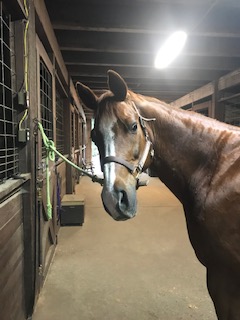
Instead, I want to take a moment to touch on how any horse can do therapy with someone. My current horse, Drummer, is 100% not what anyone would say would be a good candidate for a therapy program. He’s moody, on a bad day capricious, and on a worse day, has a penchant for acting spoiled rotten. And that’s after six years of steady improvements. He’s also a sweetheart, not prone to spooking, and well behaved in hand for anyone. (Just don’t make the mistake of feeding him a carrot or you’ll get all the negatives at once as he demands more LOL).
That being said, he is the perfect therapy horse for me. After two months of both suffering from presumed COVID 19 and recovering from it, I finally braved riding again. One of the key elements that has plagued me since I came down with the virus has been anxiety, and for quite possibly the first time in my entire life (and I’ve been riding for nearly 30 years), I realized just how big and dangerous a horse could be. I tried a simply walk around the arena, but had an anxiety attack. Drummer, bless his heart, didn’t spook when I became tense. He slowed, asking in his way if I was okay. When I couldn’t control my symptoms any longer, I got off, hugging him to let him know that none of this was his fault. Back in the barn, I struggled to remember how to do the simplest things – I couldn’t get his breast collar off over his halter, I nearly dropped his saddle. It was one of the worst moments I’ve ever experienced in the barn. However, I did my best to make sure he realized he was a champ. He took extra special care of me that night, and continued to do so when I returned two days later.
I’ve been back to riding for nearly a month now. And the anxiety has nearly disappated for something I’ve known for so long. But I’ll still startle at loud noises, still become worried by strangers walking by or even people I know being at the barn when I am. Through it all, he has continued to be as kind and gentle as he ever has been. He has been, in the last month, my true therapy horse. And for that, I am grateful. For all his quirks, I’ll take them and love them if it means I have a horse willing to help me every time he sees me.
I guess what I really want to say is that for everyone, horses can offer a bit of therapy not available elsewhere. They don’t have to be perfectly behaved or model citizens, sometimes they just have to be themselves – and we have to realize how much we need them.
Until next time…
 Haute Ecole*